Is Coffee Syrup Dairy-Free? How to Check the Label

Yes, most flavored coffee syrup is dairy-free. A typical vanilla, caramel, or hazelnut syrup is sugar, water, and flavoring, with no milk in the recipe.
There are a few exceptions. The thick caramel and white chocolate that cafés add to mochas and lattes are usually sauces, not syrups, and sauces are often made with condensed milk or cream. A small number of syrups contain dairy too, mostly cream and dessert flavors.
At a café, there's one more catch. Even a dairy-free syrup goes into a drink made with the same steam wands, pitchers, and blenders that handle milk all day.
We make single-serve flavored coffee syrup packets at 58 Peaks, and every flavor we make is dairy-free. The label check below works the same way on any brand, ours included.
What flavored coffee syrup is made of
Flavoring syrup is a simple product. Sugar dissolved in water carries the flavor, and most brands add a food acid like citric acid plus a preservative so it keeps on the shelf. Sugar-free versions swap the sugar for a high-intensity sweetener and usually add a thickener, so the syrup still pours like syrup. None of that involves milk. Dairy is what makes food creamy or thick, and a clear syrup doesn't need to be either.
That's the kind of syrup this article is about. In Rhode Island and nearby states, "coffee syrup" usually means something else: a sweet coffee concentrate stirred into cold milk to make coffee milk. The concentrate itself typically has no dairy, but the drink is mostly milk. For a dairy-free glass, mix it with oat or almond milk.
Coffee syrup vs. coffee sauce
Ask for caramel or white chocolate in your latte, and it could come from one of two kinds of bottles. One holds a thin syrup you can see through. The other holds a thick sauce that comes out more like ice cream topping. The syrup is almost always dairy-free. The sauce often isn't, because condensed milk, cream, or butter is usually what makes it thick.
White chocolate is the clearest case. In the US, anything sold as white chocolate has to contain a minimum amount of milkfat and total milk solids. The thick white chocolate sauce in a mocha usually contains milk too. White chocolate syrup is a different product. It's flavored to taste like white chocolate, and it's usually dairy-free.
Caramel is harder to call. Many brands sell both a caramel syrup and a caramel sauce with nearly identical names, and cafés use both. If it matters to you, ask which one goes in your drink.
| Flavoring syrup | Sauce | |
| Texture | Thin and free-flowing | Thick, clings to a spoon |
| Appearance | Clear or lightly tinted | Opaque |
| Typical base | Sugar, water, flavoring | Sugar plus dairy, often condensed milk, cream, or butter |
| Common flavors | Vanilla, French vanilla, caramel, hazelnut | Caramel, white chocolate, mocha, seasonal spice blends |
| How it is dispensed | Narrow pump, or a sealed single-serve packet | Wide nozzle pump, squeeze bottle, or ladle |
| Dairy | Rare | Common |
If it's thin and see-through, it's a syrup. If it's thick and opaque, treat it as a sauce until the label says otherwise.

The syrup flavors that do contain dairy
Syrups containing milk are usually easy to spot by name. Look for cream and dessert flavors like sweet cream, Irish cream, and dulce de leche. Craft and small-batch makers sometimes use real cream or condensed milk in these, since dairy is the easiest way to get that rich taste.
The flavor's name won't tell you for sure, though. Two brands can sell the same flavor, and only one of them might use real dairy. Milk can also come in through a flavoring instead of being listed on its own. Either way, the label has to say so, and that's where you'll get the real answer.
How to check a coffee syrup label for milk
The label will tell you. Milk is one of the nine major food allergens, and federal law requires any packaged food sold in the US to name it on the label if it's used to make the food.
Where milk shows up in an ingredient list
Milk will show up in one of two places. The first is in parentheses right after an ingredient, like "whey (milk)" or "sodium caseinate (milk)." The second is a Contains line next to the ingredient list, like "Contains: Milk." Brands only have to use one of the two, so check both spots.

A lot of people worry about "natural flavor." Brands can usually list a flavoring without breaking down what's in it, under a rule that predates allergen labeling. Allergens are the exception. If a flavoring contains milk protein, the label still has to say milk.
Why "dairy-free" on the front is not a defined claim
The FDA has a rule for "gluten-free," with conditions a product has to meet before qualifying for the phrase. Outside of gluten-free, no regulation sets the conditions for a "free-from" claim. That makes "dairy-free" a voluntary label. Brands still have to be truthful, and the FDA has said it expects a product labeled dairy-free to contain no milk from any source. There's just no official limit or test behind the phrase.
The FDA has checked how well the claim holds up, at least for chocolate. When it sampled chocolate products labeled dairy-free from stores, 13 of 210 tested positive for milk. All 13 also said they were made in a facility that processes milk. If you need to be sure, the FDA suggests contacting the company to ask how the product is made, whether it uses dedicated equipment, and whether it tests to confirm the claim.
Non-dairy does not mean dairy-free
The two sound interchangeable, but federal rules treat them differently. A product labeled non-dairy is allowed to contain caseinate, which is a milk protein. The ingredient list only has to say where the caseinate came from, with wording like "sodium caseinate (a milk derivative)". Non-dairy creamer is where you'll run into this most. If you're avoiding milk, treat "non-dairy" on a package as a reason to read the ingredients.

Can a dairy-free syrup be made in a facility that handles milk?
Yes, and the label may not say so. Warnings like "may contain milk" or "made in a facility that also processes milk" are voluntary, since the allergen labeling law doesn't require them. A label without one doesn't prove much. A label with one doesn't tell you whether any milk actually ended up in the product. The FDA has also said a dairy-free claim and a "may contain milk" warning contradict each other and should not appear together. If it matters to you, ask the manufacturer. Their contact details are on the package.

What happens at the café counter
A drink made to order doesn't come with an ingredient label, since labeling rules only cover packaged food. The bottles behind the counter do have labels, though, so at a café, you get your answer by asking.
At most cafés, dairy is more likely to come from somewhere other than the syrup:
-
Steam wands and pitchers get shared. Most cafés steam dairy and plant milk with the same wand, and a pitcher often gets a rinse between drinks instead of a full wash.
-
Blenders and cold foam equipment get shared too. Milk sticks to blades, lids, and seals, and these also tend to get a rinse between drinks rather than a full wash.
-
Toppings often have dairy. Whipped cream is dairy, and caramel drizzle often is too, so ask for them to be left off if your drink comes with them.
That doesn't mean you have to skip the café. A few specific questions will get you a clear answer:
-
Is the caramel a syrup or a sauce? If the barista isn't sure, ask to see the bottle.
-
Can I see the ingredients on that bottle? Any packaged syrup or sauce has a list.
-
Could you steam my milk in a clean pitcher?
Ordering iced helps too. An iced coffee is usually just coffee, syrup, and milk poured into the cup, so it skips the wand, the pitcher, and the blender.

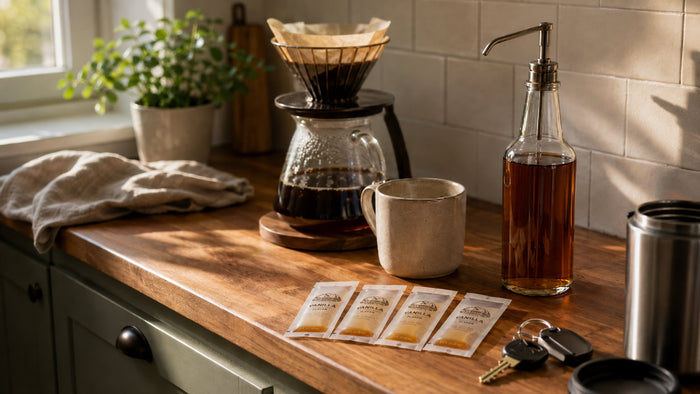
Bringing your own syrup is another option. A single-serve packet has its own ingredient label and stays sealed until you tear it open. That's one reason some people carry sealed single-serve packets when they order out.
Are 58 Peaks coffee syrups dairy-free?
Yes. Every flavor we make is dairy-free and gluten-free. As of this writing, our core lineup is six flavors, and we add new and seasonal ones as we go. Each packet holds 15 mL of liquid syrup, about two pumps from a café bottle, which is enough for a 12 to 16 oz drink.
There's no third-party certification behind that, and we won't call it one. Dairy just isn't an ingredient in anything we make. Our syrup is made in Colorado Springs with Rocky Mountain municipal water, and the full lineup is on our site. Every packet lists its ingredients, and if you have a question before you buy, you can email our team at info@58peaks.shop.
Is sugar-free coffee syrup dairy-free?
Most are, but "sugar-free" on its own doesn't tell you. It describes how a syrup is sweetened, not whether there's milk in it. Our sugar-free flavors are dairy-free like the rest of the line. For any other brand, check the label the same way you would for a regular syrup.
Where to start
If you want to try ours, the 20-count Variety Pack is where most people start. It has four flavors in one box, all dairy-free, and each packet stays sealed until you tear the top off and pour. It's the easiest way to find the flavor you'll keep buying.
Shop This Story
-

 The Coffee Companion You Didn’t Know You Needed You bring your own coffee bea...$20.00